
Decompose to Recompose
Reflections from Future Days 2026: How to sit with tension, let things go and grow a decomposition economy. Or: we don’t need more fucking chairs.
A furniture designer caught me at a 3 Days of Design party on day one of Future Days 2026 in Copenhagen. She’d seen my work. She said: “We don’t need more fucking chairs. I’m going to decompose my company.”
Two weeks later, I process what it is to be working in futures today.
We spent three days in Europe’s design capital; brilliant people with a knowing consensus around urgent systemic change. Then most of us went home.
I came home to London’s cost of living and a heatwave. To a piece I wasn’t sure how to write, on which lesser-evil platform. To Sporesight trying to balance what I value with how I live. To the knowledge that my newborn nephew will most likely experience a +3°C planet at minimum.
TENSIONS: Possibility and Defeat. Idealism and Blockers. Lo-TEK and Technosolutionism. Regeneration but Capitalism. Openness to change but still: Business as Usual.
I don’t say this to perform struggle. I say it because Imandeep Kaur - civil activist and the only speaker at Future Days who truly told it like it is - reminded us that we are all complicit in horrors we don’t like to name or face.
One example of many: the minerals inside the devices we use to post our reflections are extracted from active conflict zones. Meeting net-zero targets by 2050 requires six times more mineral input than today, drawn predominantly from countries living inside ongoing instability, corruption, and war. I've written about this after visiting friends who fled eastern DRC violence and are now living with refugee status in Uganda (here and here).
Imandeep shared:
“The scale and severity of the polycrisis is forcing us to systematically re-evaluate the speed and scale of transition facing our built environment and the social fabric of our neighbourhoods.”
It’s a lot to hold. I’m holding it imperfectly.
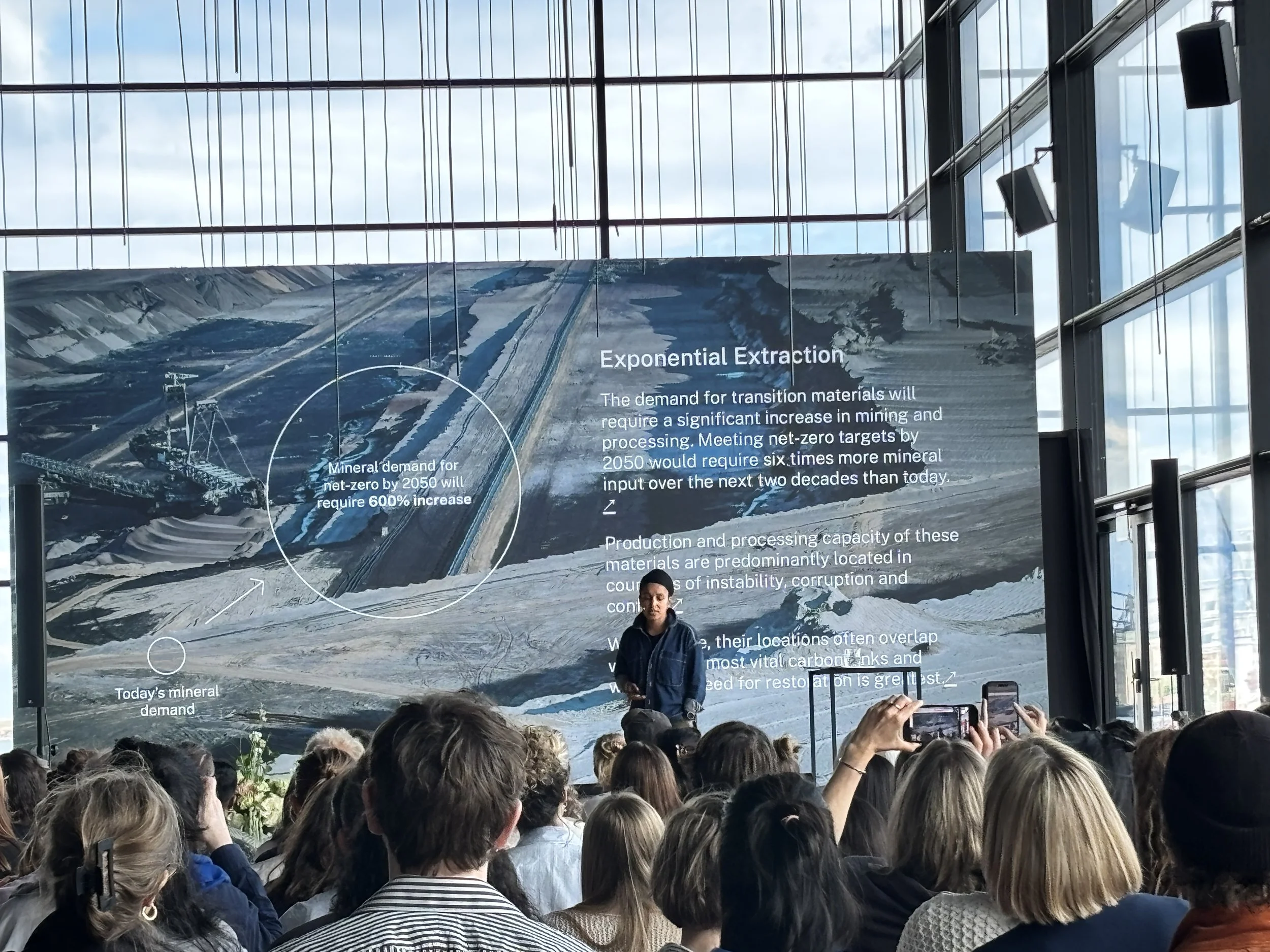
Imandeep Kaur of Civic Square at Future Days 2026 in Copenhagen
The speakers wove a thread of emergence
Shoukei Matsumoto: the currents of tomorrow are already flowing. We can only sweep, and leave things a little cleaner for those who come next.
Anab Jain: what if we stopped treating nature as a resource to serve our technology, and instead used technology to serve our more-than-human world? She also said this, which perfectly set up Sporesight's side event, Growing the Decomposition Economy:
“Everything that is made must be unmade so that it may be made again anew. For the Market hungers for the New, and loathes that which remains.”
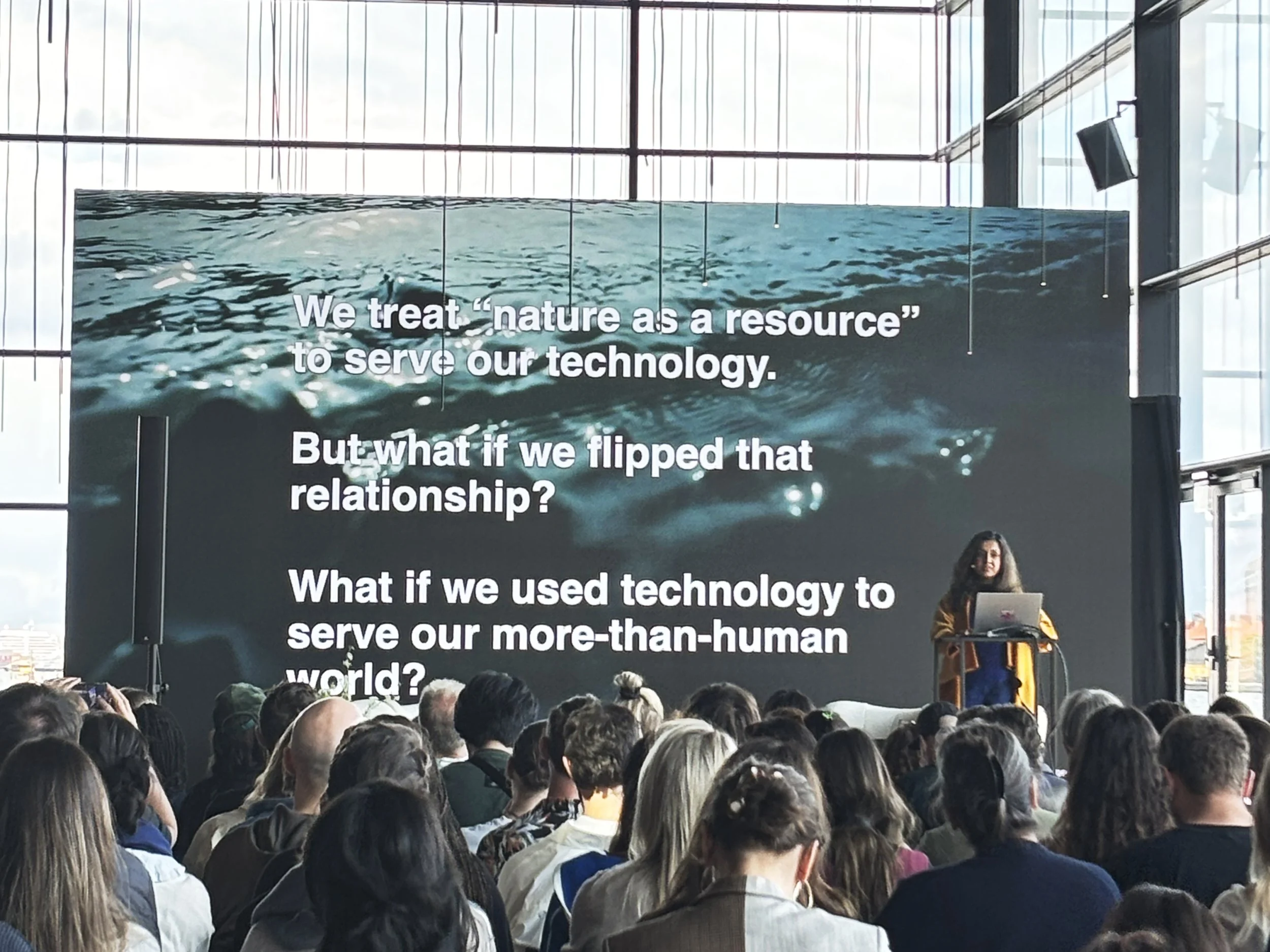
Anab Jain of Superflux on stage at Future Days. This slide: “We treat ‘nature as a resource’ to serve our technology. But what if we flipped that relationship? What if we used technology to serve our more-than-human world?”
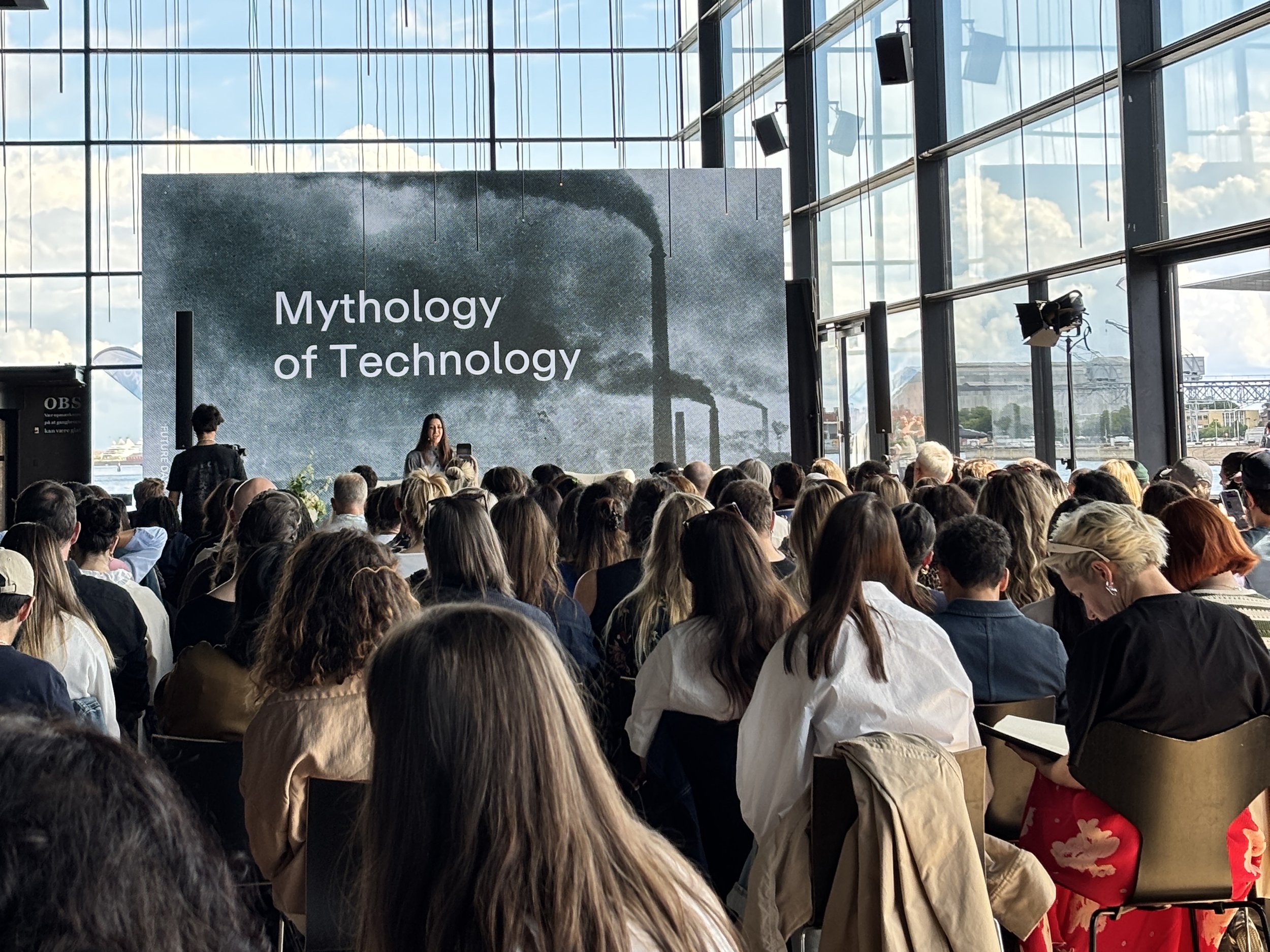
Julia Watson of Lo-TEK Institute. This slide: “Mythology of Technology”
Julia Watson: we already have all the solutions we need. Think Lo-TEK design – local, traditional, ecological knowledge. Bioregional models. The knowledge exists. So why don’t we just do it?
Imandeep’s answer was the clearest I’ve heard:
“We don’t have to repeat imperial and colonial futures to create thriving futures… We can do this by design, or be forced into it.”
I don’t see this as idealism; I see it as a design brief.
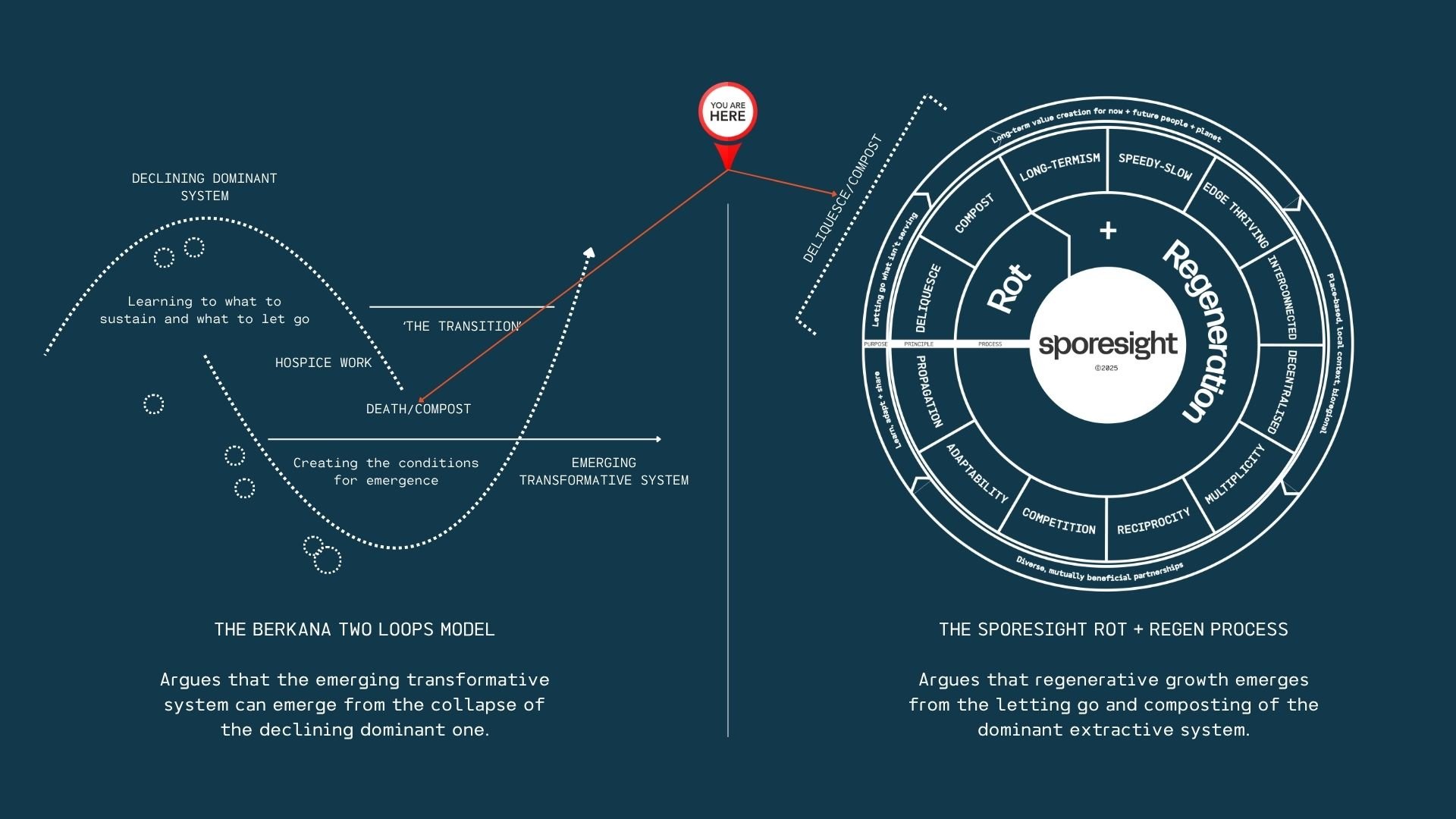
The two loops and the Rot
On day one, Nicklas Larsen of Copenhagen Institute for Futures Studies applied the Berkana two-loop model to Copenhagen city — ‘hospicing’ declining dominant systems while creating conditions for what’s emerging. It validated something I’ve been building Sporesight around: start with rot, before regeneration. Let go of what isn’t serving. Decompose existing extractive structures to create new forms of value for what comes next. Phew! Day 1 has nicely set up how I’ll close day 4.
On this day, a group of us huddled under the stairs and playfully named some things that could decompose: forms of identity that require extraction to sustain? the nation state as a default unit of belonging? death economies? Whale fall: when a whale dies, its body feeds an entire deep-sea ecosystem for decades. The death is the gift.
How poetic to bring this frame to our organisations?
Thank you Joshua Stehr, Hannah-Sophie Wahle, Thays Prado and Phillipe Arnez for this moment.
A quick note on frameworks: There are many regenerative approaches out there, and I’ve heard some concern within the regenerative community about needing one consistent language. True regeneration is place-based, which means there’s no universal framework. I believe that it’s okay to use different frameworks - choose what fits your context, your people, your bioregion.

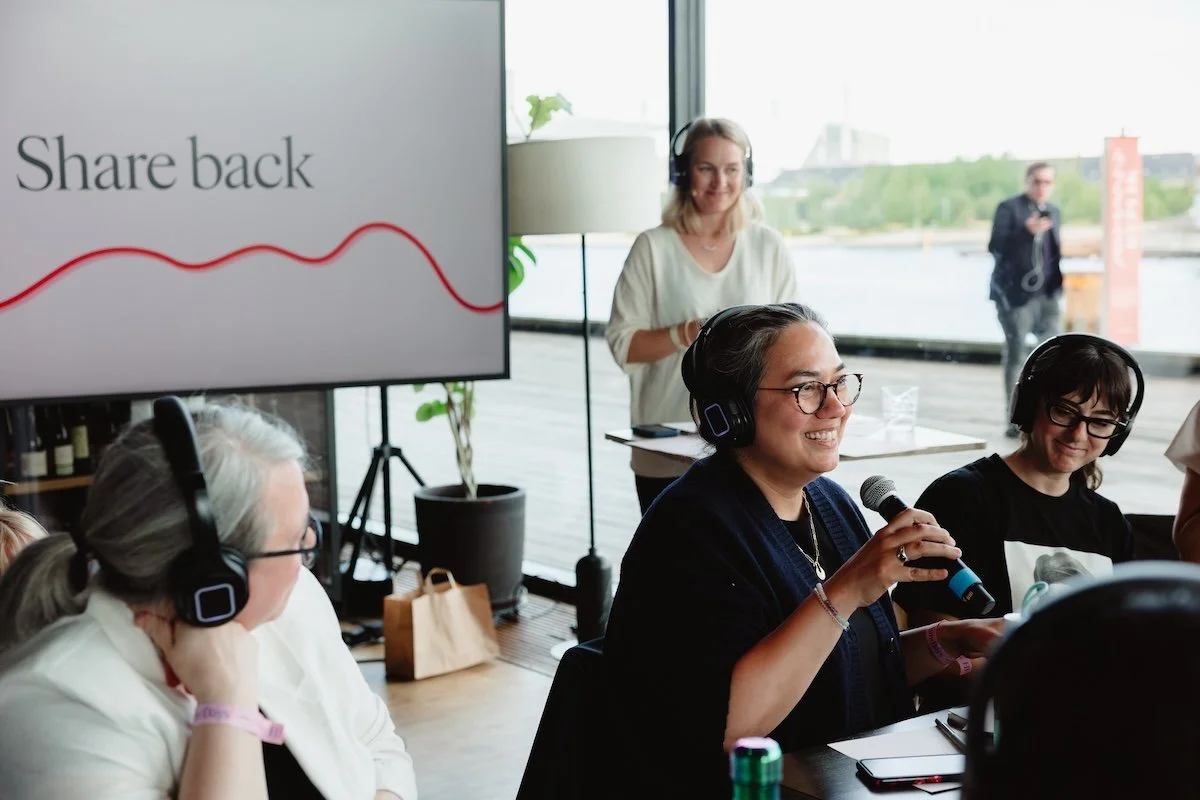
H&M Exploration Lab at Future Days - Elizabeth Hofvenschiöld sharing back on behalf of our team. Photo: @dani_bains_creative
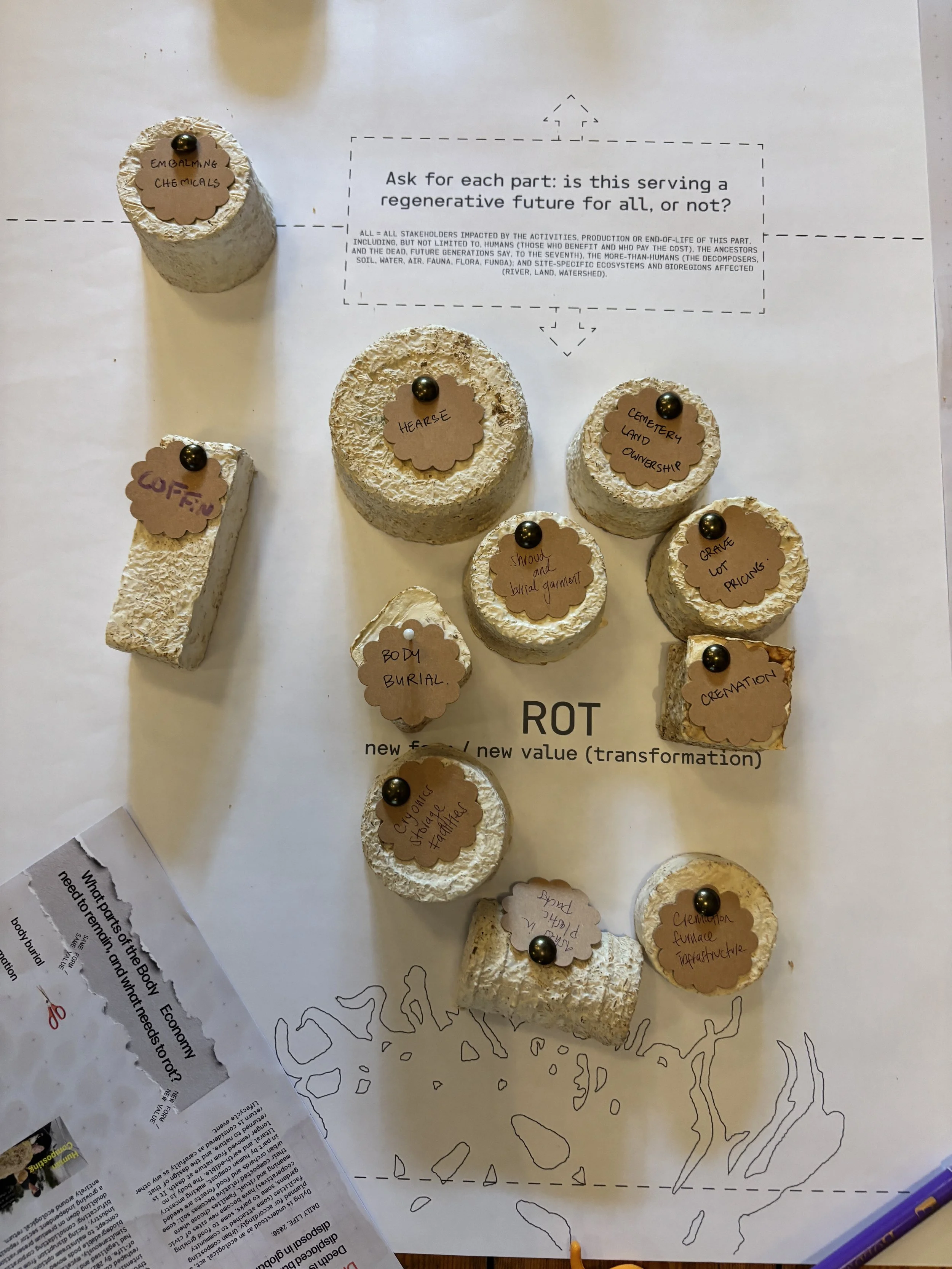
Sporesight’s Growing the Decomposition Economy is a masterclass in decomposition practice: how to unlock new forms of value by breaking things down.
Decomposition practice, for new forms of value
Sporesight's Decomposition Strategy maps three outputs of any initiative when it's dismantled and examined:
REMAIN — what holds value in transition
ROT* — what transforms into new value through breakdown
WASTE — what has no redemptive pathway and needs to be named as such (and then, ideally, composted)
The shift from symbolic to substantive happens when leadership is willing to name, publicly and specifically: what needs to rot. That takes courage and it’s also where genuine regeneration begins.
During H&M Foundation’s Lab at Future Days, our group sat with the tension of what I value vs how I live. We landed here: capitalism isn’t ending — it’s being re-coded. Capital = money is giving way, slowly and resistantly, to capital = new forms of value. Relational. Ecosystem. Care. Skills. Reciprocity.
Ecosystem over ego-system.
Anab and Imandeep both said it: we get to choose what we foreground. So I’m choosing this frame deliberately. Not utopian fantasy. Not collapse paralysis. Not future deprivation.
I choose to reframe collapse as intentional decomposition — which means holding the reality of what’s collapsing while refusing to surrender agency over what comes next.
*A note on nature metaphors. We use rot, decomposition and compost almost interchangeably — but ecologically they’re distinct. Decomposition is the umbrella process; rot is one wild mode of it; and compost is that same process deliberately harnessed into a product. In Sporesight sessions we keep the metaphors grounded in the science, rather than collapsing the complexity of these processes into a single convenient shorthand.
Four things I’m taking forward.
4. Where are you most legitimate? Imandeep’s provocation: don’t try to change everything. What can you do in your community, your neighbourhood, your family? I’m starting in Brixton, London, England.
3. Who are you doing this with? Nobody can do this alone. We’re operating in systems designed to disempower. Going forward, I’m doubling down in multiplayer futures communities: RADAR, IMMA Collective, South London Mushroom Club. I’m also exploring Sporesight as a CIC.
2. How can capital be composted? My current fav is diving into Dr. Chloe Hill’s thinking around composting philanthropy for systems change - the kind that releases money without control, without ego, without conditions attached.
And this: decompose to recompose.
1. Start here: Decompose before you recompose. Stop asking what can we create next? Start asking what needs to rot first?
Again: we don’t need more fucking chairs. Before you build, before you scale, before you innovate — identify what is extracting, what is not serving, what has no redemptive pathway. Name it. Let it go.
Decompose it to nourish the emergence of a transformative system.
Yours in spores,
Jess Jorgensen
Sporesight Foundress
