
Fungi as your futurist: rot, to regenerate
What if we could think regeneratively, by thinking more like fungi?
Reading time: 8 mins / Meditation time: 12 mins
Image description: Grainy, treated image of polypore mushroom overlaid over the same image. Text reads: ‘Sporesight. Fungi as your Futurist.’
It's 2026 and the masks are off. Someone says "sustainable growth" in a strategy meeting and I feel that familiar cringe in my gut. Because I know (even if I can't say it out loud) that the system we're optimising wasn't designed for longevity, but for extraction.
My motivation for more regenerative ways of being runs deep, but I’m facing a dilemma: how to start, within the corporate cage, slashed budgets and global uncertainty dimming my change-maker fire?
Today, I’m inviting you to explore with me how nature's intelligence can help us navigate uncertainty and design more regenerative, equitable futures together. It’s an invitation to think more like fungi, and a practical starting point to embodying nature’s intelligence in our worlds – starting with rot.
The brilliance of human “intelligence”?
We find ourselves living within inequitable systems purposefully designed to benefit the wealthy few, while staring down the barrel of ecological and systemic collapse. Whether you're tuned to Davos' "end of rules-based order" tropes, the astrological shift of Saturn into Aries, or enlightened Reddit sages, 2026 is being dubbed 'the year everything changes.'
The painful truth is that human intellect has created a relentless drive for ‘growth at all costs’, creating an existential tension in balancing human progress with nature’s needs. In my sector, this manifests as corporations deploying big budgets, research, foresight, frameworks, KPIs and insurmountable resources to do one thing: extract more efficiently from people and our planet.
We’ve built anthropocentrically brilliant systems that are ecologically… stupid. Yay team.
Lady Jane G was right:
“We are the most intellectual creature that has ever walked the planet. But I carefully say intellectual rather than intelligent because if we were intelligent, we would be caring for our only home.”
If this all feels a bit eerrghghggehg (word of the year?), you're paying attention. How do we navigate this hypernormalisation of unbelievable status quos – at home, let alone in our work?
What if there's an intelligence smarter, bigger and older than ours that we've been ignoring? And what if that intelligence has already solved the exact problems we're trying to fix? I’m not referring to artificial intelligence, but the intelligence of nature.
Collapse isn’t an ending – it’s rot before regeneration
Acknowledging these realities can feel equally eerrghghggehg. Eco-anxiety and the loss of human-centredness, facing overwhelm with disbelief and paralysis (bunker down, head in sand) are all understandable symptoms of paying attention.
But we decide which story we're a part of – we can choose to switch off, or to shape change, with agency.
No problem is ever solved from the mindset that created it. Donella Meadows famously identified that the deepest leverage points for change require stepping outside a system’s dominant worldview, even while working within it.
If we want to emerge in 'throughtopia' (finding a path through this present towards a future we’d be proud to leave behind – thank you, Manda Scott), we need to think differently. To tell ourselves stories predicated on meeting human needs in ways that strengthen (rather than destroy) the systems we depend on.
Even amid a chaotic wobbly patch, there is space and time to reframe this ‘collapse’ as a natural rotting (composting, decaying, letting go) of that which doesn’t serve, making space for renewal and regeneration.
Thinking differently isn't about abandoning your work, your company, your role, but rather about tuning into a different intelligence, considering how we relate to the web of life and how we relate to our futures (plural, because there are many versions of the future, and we have the power to shape them).
Fungi Foundation’s Giuliana Furci says it best: rot ‘n mold is the new rock ‘n roll!
Exploring a new intelligence
Around five years ago, my appetite for purely anthropocentric strategy reached its limit. I started asking: how can nature's intelligence help us imagine equitable futures?
So I traveled five continents, interviewing 80+ pioneers in fungi innovation and nature-centric thinking. Nature's intelligence creates conditions for everyone/thing to thrive, be resilient, and regenerate. I wanted to learn from the humans – and fungi – who are challenging the human-nature disconnect sitting at the heart of our ecocidal tendencies.
“Fungi weren’t my subjects. They became my partners. I was observing them. But also, listening to them.”

Image description: “Listening to fungi” moving gif showing close-up of human ear ‘listening’ to various mushroom species, followed by a portable hard drive with the words, ‘We’ve been listening. We’ve got the downloads’.
Fungi challenge traditional ideas of intelligence
Fungi have all these cool strategies to get our attention. Tangibly, fungi innovation is creating sustainable options in food and drink, biomaterials, packaging, wellness, construction. They can eat plastic and cigarette butts. Through mycoremediation, they clean polluted soil and waterways.
Underground, the 'wood wide web' has captured imagination, showing us how, without brains, some fungi process information.
In Ways of Being, James Bridle describes mycorrhizal networks as a kind of shared sensing and signaling system, in which trees and fungi form a distributed ‘nervous system of the forest’ that enables nutrient exchange, cooperative support of seedlings, and warning signals about threats. How cool?
This challenges human-centric ideas of where intelligence resides.
As a decentralised, distributed, interconnected intelligence, fungi solve the exact problems we struggle with: resource distribution, waste management, communication across difference, resilience through change.
““You could argue fungal intelligence is greater than humans in the way it manifests as decentralised intelligence. Often humans can get in the way of themselves because we’re so individually intelligent.” ”
Fungi are bigger, older and more successful than us and are responsible for sustaining all life on Earth. Without fungi, we wouldn't exist.
Yet, for all that we know, there is more that we don't. We know less about fungi than the deep sea. We know less about the deep sea than the moon. The kingdom (or Queendom, or Queerdom) of Funga (Fauna. Flora. Funga.) is still largely unstudied, overlooked, feared or misunderstood. This is a vast universe we're only just discovering.
This truth is further evidence: human intelligence leaves much to be desired. Whereas fungal intelligence embodies 400 million years of field-tested solutions. And myco-culture, in all its forms, is an entry point: a fun ‘way in’ for people to engage with nature.
“Fungi are incredible. The more I learn the more they make me think and feel differently about the world.”
Fungi show us how think about our futures
Thinking like fungi can help us imagine possible futures, and create preferable ones. As author Doug Bierend says in In Search of Mycotopia:
"Part of the growing appeal of fungi is that they represent means, examples, and ways of thinking through which we might subvert an unsustainable status quo."
Metaphorically, fungi show us, as organisations and as individuals, how to re-think and re-design things: personally, in business, and in our relationship with our planet. If we were more like mushrooms, we'd be resilient, in it for the long haul.
Rot, then regenerate
In my research, the answer to long-term resilience wasn't in human innovation labs. It sprawled across the forest floor. Fungi teach us that decay is critical for renewal.
First, fungi ROT → Gracefully letting go of what isn't serving; allowing waste to become nourishment. In nature, death isn't the opposite of life, it's part of the cycle. Fungi's job is to break things down: fallen trees, mulchy leaves, extractive beliefs… dead things transformed into nutrients for new growth.
Then, they REGENERATE → Creating conditions for new life.
“The rot and regeneration concept challenges the dominant thinking around endless growth.”
In our evolving playbook, Fungi as your Futurist, we’re exploring how to translate fungi intelligence into practical applications for organisations, through 12 design principles which can be applied to strategy and innovation. At its best, our Rot + Regeneration framework is designed to help us:
Let go of what isn't serving,
Build long-term value creation for today's and future humans and Earth,
Root in place-based, bioregional, local contexts,
Create diverse, mutually beneficial partnerships,
Learn, adapt, and share knowledge.
Mainly, it exists to inspire regenerative futures for everyone—which includes you, and your organisation, and your multi-species neighbours. It imagines how everyone can live well, in interdependence, together.
R+R doesn't have all the answers, nor does it offer an easy path for ‘throughtopian’ emergence. Most importantly, it’s not trying to add another framework to the volume of brilliant regenerative thinking that already exists. Rather, it acts as an accessible entry point to regenerative practice, and allows us to start stepping outside of purely anthropocentric thinking.
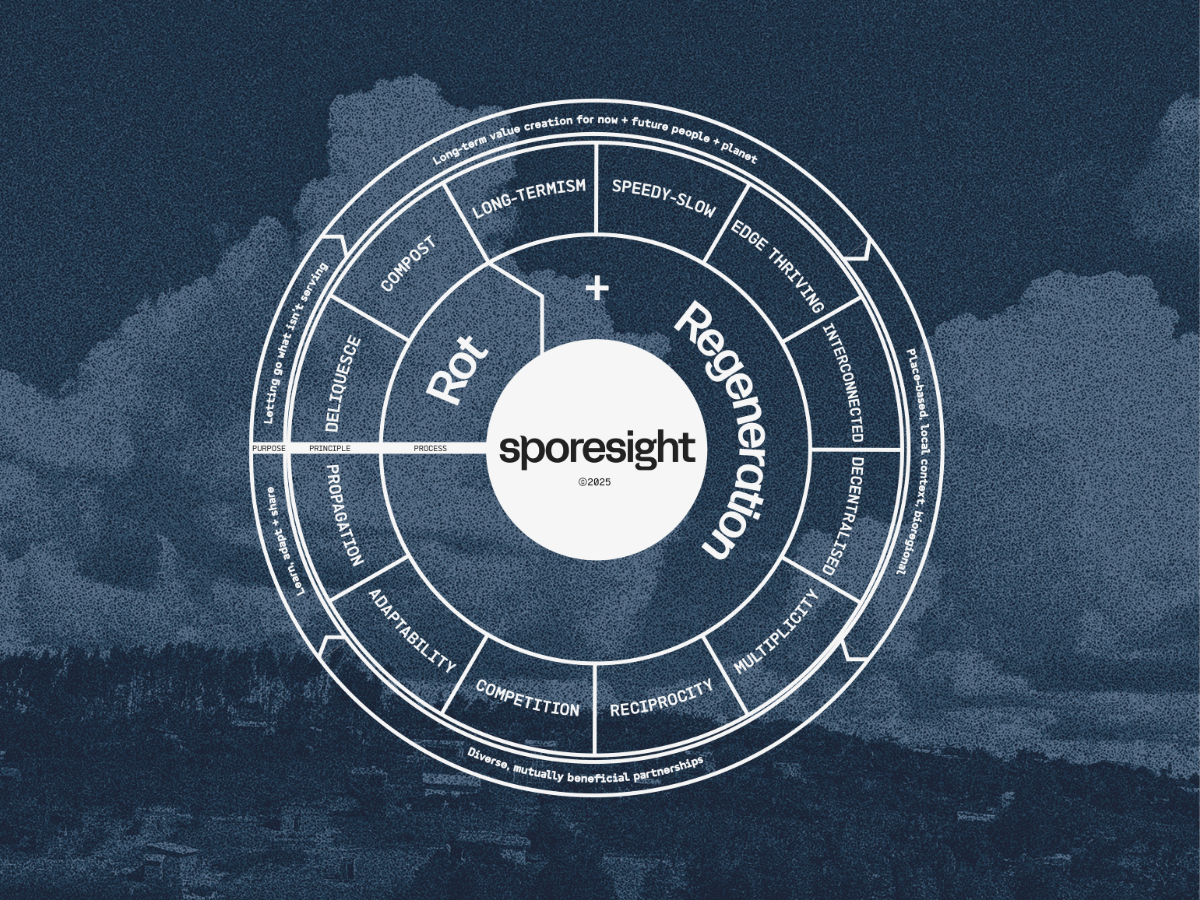
Image description: Sporesight’s evolving Rot + Regeneration framework. A central circular ‘process’ (rot + regeneration) is framed by 12 design principles: Deliquesce, Compost, Long-termism, Speedy-Slow, Edge Thriving, Interconnected, Decentralised, Multiplicity, Reciprocity, Competition, Adaptability, Propagation. The outer ring encapsulates the framework’s purpose, as mentioned earlier.
“In 2026, we’ll refine this: rot a few principles, test for proof of concept, develop real-world case studies. Want to contribute, pick it apart, or share notes? reach out!”
“...but what's the business case for this?”
In today's economic climate, justifying a budget for regenerative thinking can be met with classic paradigms like "what's the business case for this?" (Sporesight's most-asked question, alongside: "I love this, but how do I convince my boss/company/capitalism?")
Starting feels impossible when we're already navigating systems designed to resist this kind of thinking. Which is exactly why Rot + Regeneration doesn't ask you to regenerate anything yet.
Start with rot. Just rot.
Let go of what isn't serving, trusting that your discomfort with extractive systems is intelligence, rather than idealism. You don't need a business case to dismantle a strategy built on paradigms that are already collapsing. You just need permission to let it decay.
Slowly, emergently, like a matsutake waiting for the right conditions to fruit, the regeneration comes after.
Coming up, we'll decompose-to-recompose (exploring how to compost the narratives that aren't serving us), then tackle "what's the business case for regeneration", exploring how to bring this conversation into your organisation without making it weird.
For now: An invitation to feel like fungi
Thinking like fungi starts with listening: not intellectually, but somatically. What does it actually feel like to be more like a mushroom? To embody rot, reciprocity and long-term resilience?
For now, our invitation is only to listen to our 12-minute meditation and notice what shifts:
→ Listen to the Sporesight meditation
Written and voiced by Thays Prado with sound design by Michael Saal
Image description: Pleasant radial symmetry in a delicate mushroom cap, with text, ‘experiment with how it feels to be a little bit more like a mushroom. Written and voiced by Thays Prado with sound design by Michael Saal.’
In March at The Summit in Copenhagen I’ll be sharing an AI x Foresight x Fungi lens for long-term organisational readiness.
Just gone: Good Innovation talk on lessons from nature for charity sector innovation.
Yours in spores,
Jess
Founder, Sporesight
